Craft,engineered.
A design & technologypartner for modern brands

Award-winning websites, apps, and digital content, built with craft and AI.
A short point of view from us on what actually changed in how we work and how the parts that matter didn't change at all. But first, here's some work:
Replit Agent 3
The launch landing page for Replit's autonomous AI Agent 3.
Serve Robotics
Brand refresh and website redesign with 3D assets and a design system.
Unstructured
A playful brand site turning complex data into characterful design.
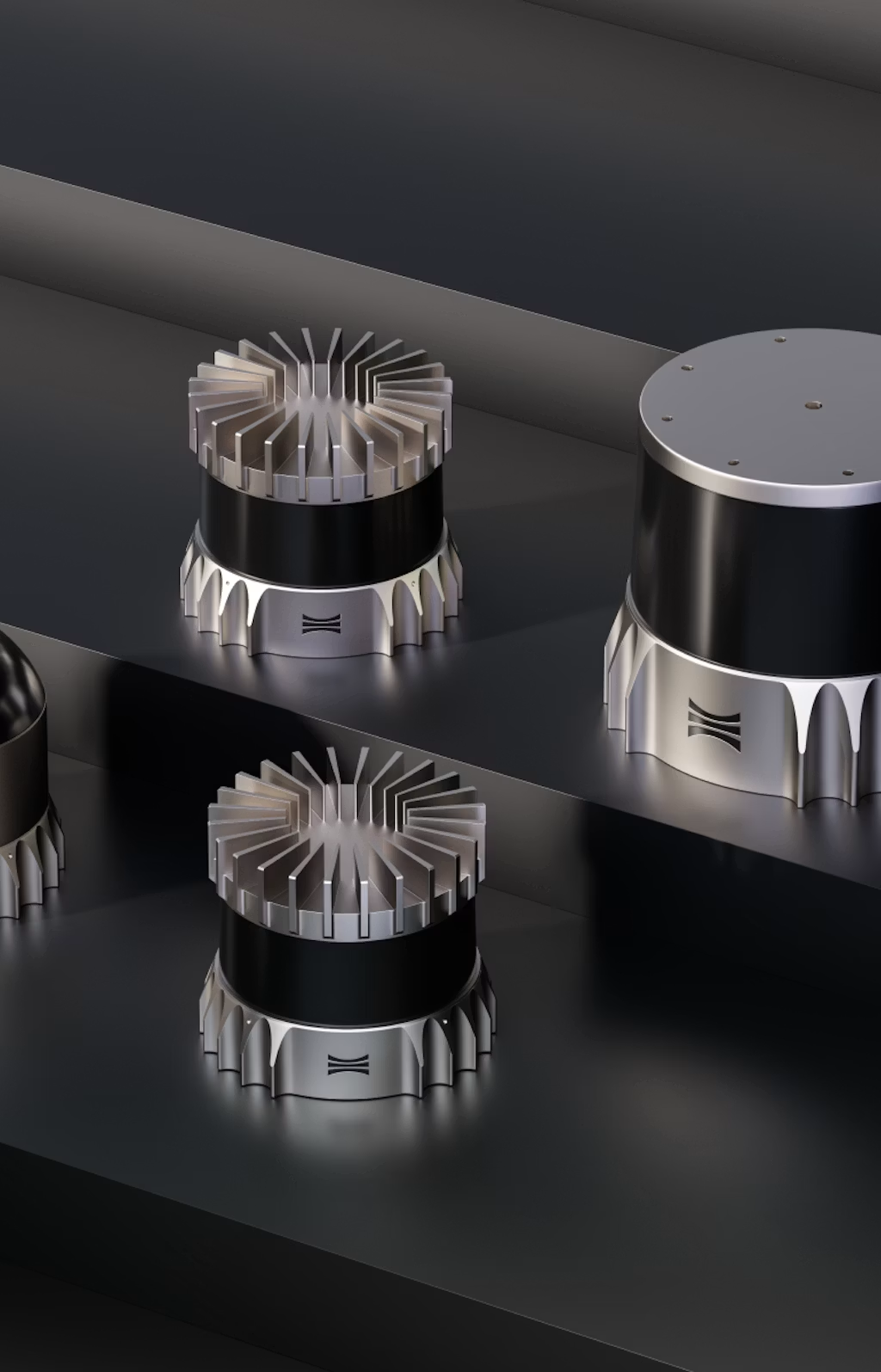
Ouster
A platform with the same precision as the lidar hardware: a new palette, a technical type system, and custom 3D product renders.
IBM watsonx.data
Two WebGL modules for IBM's THINK Tour, built with VTProDesign, running offline on touchscreens, localised and accessible.
The Ordinary
A microsite for the GF 15% Solution launch with Uncommon, taking on skincare myths and making the science honest.
Montefiore Einstein
A WebGL journey through space to find hidden stars, turning thousands of rare diseases into something approachable.
Tersa
A new brand and an immersive web experience with headless Shopify pre-order, for the human in every athlete.

Nutrafol
A brand refresh for the hair-wellness leader: a new palette, refined type, and a streamlined design system.
Born in Vienna, where craft is a discipline.
Where we come from
In 1903, a few streets from our studio, the Wiener Werkstätte put artists and craftspeople under one roof. Furniture, type, posters, whole buildings, all of it held to the same standard.
Their idea was simple to the point of stubbornness: the things people use every day deserve as much care as the things that hang in a gallery. So they kept the makers close and refused to let anything half-finished out the door.
A century later we're around the corner, working much the same way. One team, one set of eyes, and nothing left to run on its own.
AI is good at everything except the last 10 percent.
What changed
The tools are very good now, and everyone has the same ones. A first draft, ten variations, working code: what used to take a week takes an afternoon.
Which is why volume stopped being the hard part. Point AI at a blank page and it gives you back the average of everything it has already seen. Competent enough, and instantly forgettable.
Producing a lot of work quickly, and getting a rough first version of almost anything in front of you.
Knowing which of those versions is actually any good, and having the nerve to throw the rest away.
And that last ten percent is where the real work lives. It still takes 90 percent of the effort, and it's the part you have to do yourself.
Explore. Generate.
Refine. Scale.
The machine makes the options, we make the calls. In practice that works out to roughly 60 percent exploring, 20 building, 20 refining.
We can go further than we used to, and faster: interactions and shader code, not just static layouts.
It rarely lands first try, so we curate and keep tuning the prompt and the inputs until it does.
We keep what's working, fix what isn't, and take it the rest of the way.
Once something works, it becomes a system we can reuse.
The Brand Context Protocol.
We make your brand AI ready
Our first product. Every brand we work with ends up with one: a single source that holds the voice, the design and the rules, written so a person and an AI can both use it. It's what we generate from, and what we check everything against. The four parts below are how it works.
Read the full storyThe one place that holds the voice, the design and the rules we build everything from.
A job the system has been taught to do your way, ready whenever you ask for it.
The finished work, drawn from Brand Truth and on-brand the moment it arrives.
A score on every output, and what it learns goes back into the source.
Move your organisation up the levels of AI.
Passing on our learnings
This is the other half of what we do. We're a design and technology studio working with AI every day, on our own craft and our clients', and most of what we've learned is teachable. So we pass it on: pilots that prove a real use case, hands-on workshops, upskilling for your team, and the change management that makes any of it stick.
It starts with where you actually are. AI adoption has levels, a bit like self-driving cars: at one end someone is pasting prompts into a chatbot, at the other a system runs whole jobs on its own. Most organisations are idling in the assisted-parking phase, and we help you move up a level at a time, so the tools compound instead of gathering dust after the demo.
- L1Chats. People prompt by hand. Helpful, but nothing compounds.
- L3Workflows. A task done the same good way every time, with a human reviewing.
- L5Agents. Whole jobs run end to end, while people stay on the calls that matter.
We know where the line is, and we'll happily talk you out of the AI idea that's going to embarrass you in six months.
The tools are everywhere. The judgment isn't.
For our creative team, AI has turned into a new layer of expression. The craft isn't new, but it used to need an engineer in the loop. Now a designer can build real interactions, motion, and shader work directly, which lets us take a client's project somewhere more distinctive than a static screen ever could.
Wild Week Athens
A complete event site in 1.5 weeks with 1.5 designers. Proof that taste is what makes the tools worth anything.
Very fluffy
We asked how fluffy we could make it. The answer: very.
Active heads
Playing with Active Theory's activeframe library, pushed somewhere it wasn't meant to go.

A reliable asset pipeline
Turning generative chaos into a repeatable system, with a dither heatmap finish.